UNDISCOVERED PRESS
Stories that invite you to question what you think you know.
Undiscovered Press publishes fiction that explores the boundaries between history, belief, skepticism, and the questions that remain when certainty begins to crack.
CERTAINTY
What if you could go back and see for yourself?
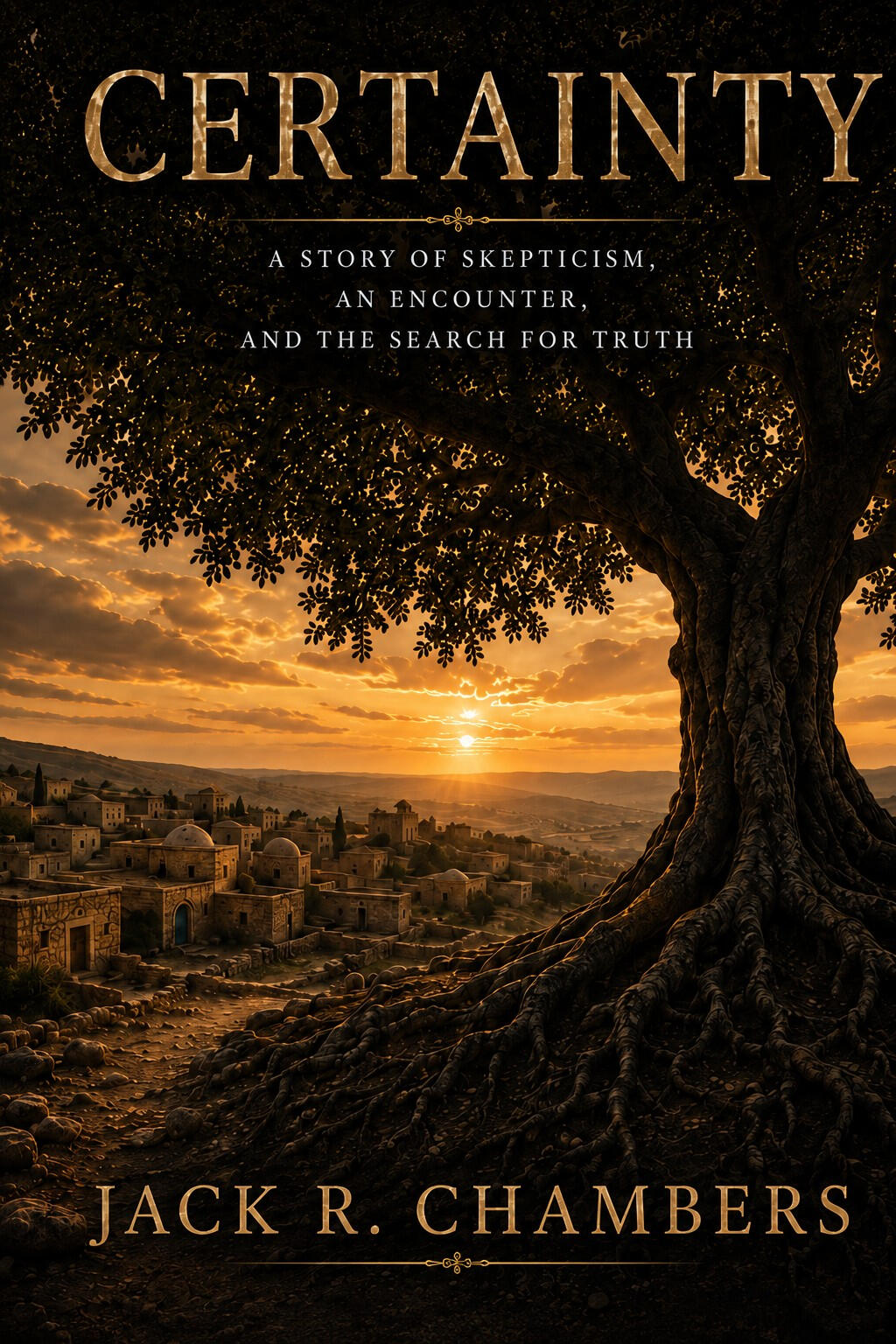
THE STORY
Jacob Wells has spent a lifetime believing history can explain everything.When an impossible scientific discovery offers him the chance to witness one of history's most significant moments, he expects evidence.Instead, he finds something entirely different.Stranded decades before the moment he intended to witness, Jacob becomes part of the quiet life of an ordinary family in an overlooked village. As the days pass, long-held assumptions begin to unravel—not through spectacle, but through the simple humanity of people history barely remembers.
What happens when the evidence you've spent your life seeking changes the question itself?
THE QUESTION
If you could go back in time and witness one moment in history, what would you choose?
Would you look for proof?
Would you look for answers?
Or would you simply want to see what really happened?
And what if what you found challenged everything you believed?
BEFORE YOU READ
Imagine you were given the chance to witness one moment in history with your own eyes.You could choose any moment. Any place. Any person.
What would you choose?
WHAT IF YOU'RE WRONG?
We all carry ideas we believe are settled.About history.
About faith.
About science.
About other people.
About ourselves.Some of those beliefs were carefully examined. Others were inherited, repeated, or simply accepted because they made sense at the time.But what happens when something comes along that doesn't fit?Do we examine the evidence honestly?Or do we protect what we already believe?Certainty isn't a story about proving someone right or wrong.It's about what happens when the walls we've built around our understanding of the world begin to crack.Because sometimes the most difficult question isn't “What do I believe?”
It's “What would it take to make me reconsider?”
Every mind has a door. The question is whether we're willing to open it.
ABOUT THE AUTHOR
Jack R. Chambers began writing fiction at 49, after a life spent pursuing a wide range of interests and careers. He has long been drawn to stories about personal transformation and the moments when people are forced to reconsider what they believe they know.His interests include history, science, philosophy, and the intersection of faith and skepticism.
Certainty is his debut novel.WHY I WROTE CERTAINTY?Certainty began with a simple question: What kind of story could actually change someone's point of view?I have always been drawn to stories about personal transformation. I'm sure readers will notice parallels to Dickens's tale and Sagan's "Contact" ...they are some of my favorites—not simply because they tell compelling stories, but because their characters encounter something that forces them to reconsider what they thought they knew.As Certainty began to take shape, I kept returning to that idea.What would it take to genuinely shake someone's certainty? Could a story open a door in someone's mind that they had kept closed? Could fiction, even in some small way, inspire someone to look at the world—or themselves—differently?Those questions shaped everything in this story.I wanted the extraordinary elements to feel grounded in the ordinary. I kept asking myself: How would I actually react if this happened to me? What would I believe? What would I doubt? What would it take to make me question something I had spent my life believing?There is another reason that question matters to me.We live in a time when people can become deeply entrenched in what they already believe—personally, politically, religiously, and otherwise. That isn't limited to one side or one point of view. All of us are capable of closing the door before we've really considered what might be on the other side.I don't expect a novel to solve that problem.
But if Certainty causes one person to pause, reconsider something they thought they knew, or let a little light into a room they had kept closed, then I will consider it a success.That's why I wrote this story.
READ AN EXCERPT
The Letter
The envelope was waiting on Jacob's desk when he returned to his office the next morning.
It had no university letterhead.
No return address.
Only his name, typed neatly across the front.
He set it aside while he answered emails.
Two invitations to speak.
A request from a documentary producer.
Three students asking for recommendation letters.
A faculty meeting reminder he had already forgotten twice.
Ordinary things.
The envelope remained untouched near the corner of his desk.
Eventually curiosity won.
He slid a letter opener beneath the flap.
Inside was a single sheet of heavy paper.
No signature.
No greeting.
Just one sentence.
You ended your lecture by saying that good historians follow evidence wherever it leads. I believe I have evidence no historian has ever had the opportunity to examine.
Jacob smiled despite himself.
He'd received letters like this before.
People claiming to possess Noah's Ark.
The Holy Grail.
A lost Roman archive.
An unpublished gospel.
History attracted certainty the way abandoned buildings attracted ivy.
He continued reading.
I have no interest in publicity, money, or persuading you of anything.
That was different.
If you agree to one conversation, I will ask only one thing of you.
Jacob leaned back.
Come willing to prove me wrong.
No address.
No phone number.
Only a small card tucked behind the letter.
On it was printed a date.
A time.
And the name of a café on the other side of the city.
Nothing else.
Jacob turned the card over.
Blank.
He read the letter again.
Then once more.
He folded it carefully and slipped it back into the envelope.
"Another one," he murmured.
Yet he didn't throw it away.The café occupied the corner of an old brick building that had probably served half a dozen businesses over the last century.
Jacob arrived ten minutes early.
Old habit.
He preferred observing before being observed.
The lunch crowd had thinned.
A young couple shared a pastry near the window.
An elderly man read a newspaper without turning a page.
Two college students argued quietly over a laptop.
No one looked particularly interested in historians or hidden evidence.
Jacob ordered black coffee and chose a table where he could see both the entrance and the street.
He waited.
At precisely two o'clock, the bell above the door rang.
The man who entered looked nothing like Jacob had expected.
No dramatic entrance.
No frantic eyes.
No overflowing briefcase.
He looked to be in his late sixties.
Neatly dressed.
Gray hair trimmed short.
The posture of someone who had spent decades solving difficult problems and saw no reason to hurry anymore.
He spotted Jacob immediately.
Walked over.
Stopped beside the table.
"You came."
His voice was warm.
Almost amused.
Jacob stood.
"I said I would."
The older man smiled.
"Most don't."
They shook hands.
His grip was firm.
Not performative.
Simply confident.
"I'm Jacob Wells."
"I know."
The older man gestured toward the empty chair.
"May I?"
Jacob nodded.
They sat.
A waitress appeared.
The older man ordered tea.
Nothing else.
When she left, neither spoke for several moments.
It wasn't awkward.
It was... deliberate.
While they waited, the older man's fingers found the sugar packet beside his cup.
He turned it once. Squared its edges against the saucer.
Then did the same to the spoon.
Jacob noticed but said nothing.
It seemed less a nervous habit than an old one — the kind of small order a person imposes on a table when the rest of the world refuses to cooperate.
Finally Jacob broke the silence.
"You know who I am."
"I've read everything you've published."
"I hope you disagreed with some of it."
The older man smiled.
"I agreed with your method."
Jacob raised an eyebrow.
"But not your conclusions?"
"I haven't earned the right to answer that yet."
Jacob found himself smiling.
It wasn't the response he expected.
"You wrote that you had evidence."
"I did."
"And that no historian has ever examined it."
"I believe that's true."
Jacob folded his hands.
"That's a remarkable claim."
"Yes."
The older man didn't defend it.
Most people making extraordinary claims rushed to justify them.
This man seemed strangely comfortable allowing the claim to stand on its own.
"May I ask what field you're in?"
The older man looked out the window for a moment before answering.
"I was a physicist."
"Retired?"
A faint smile.
"Something like that."
"What did you study?"
The smile remained.
"Questions that eventually made my colleagues uncomfortable."
Jacob laughed.
"I've had that experience."
"I know."
Another pause.
Then the older man reached into his coat pocket.
Not for photographs.
Not for ancient documents.
Instead, he removed a folded sheet of paper.
He slid it across the table.
Jacob unfolded it.
It wasn't a photograph.
It wasn't a manuscript.
It was a graph.
A series of impossibly precise measurements.
Axes.
Equations.
Waveforms.
Completely unfamiliar.
Jacob looked up.
"I don't know what I'm looking at."
"I wouldn't expect you to."
"What is it?"
The older man took a sip of tea before answering.
"For twelve years..."
he said quietly,
"...I've been trying to prove that I'm wrong."
Jacob studied his face.
There wasn't a trace of performance in it.
Only exhaustion.
The kind earned honestly.
"I've failed."
Silence settled over the table again.
Jacob looked back down at the graph.
Then back at the man across from him.
"What exactly have you been trying to prove wrong?"
The older man smiled.
Not triumphantly.
Gratefully.
As though Jacob had finally asked the only question that mattered.
Instead of answering, he asked one of his own.
"Professor..."
Jacob looked up.
"When an explorer reaches the edge of every known map..."
He paused.
"...is the next honest step to stop walking?"
Jacob leaned back in his chair.
"No."
"What is it?"
Jacob answered without hesitation.
"You buy a bigger map."
A pause.
"I was hoping you'd say that."
Outside, traffic moved lazily through the afternoon.
Inside, two cups rested untouched between them.
Jacob had the unmistakable feeling that he had just stepped into a conversation that had begun long before either of them sat down.
He had no idea where it was leading.
Only that, for reasons he couldn't yet explain, he wanted to hear what the man had to say.
He studied the man across from him — the plain tea, the careful hands, the willingness to let an impossible claim sit unproven.
Jacob didn't believe him.
Not yet.
But he recognized something he rarely found in people making extraordinary claims.
Restraint.
And restraint, in Jacob's experience, was the rarest form of honesty.
Certainty is here.
Available in paperback, hardcover, and ebook.